
Why most AI pilots die before production - and what separates the survivors
 Praveen R
Sep 2026
Enterprise AI in Production - Part 5 of 5
Across this series I've argued for one idea from several angles: production wants predictability, and the winning architecture lets AI discover while deterministic systems execute. This final part is the reality check - because the data on what's actually happening in enterprise AI is sobering, and it explains why this matters.
The numbers behind the hype
Strip away the marketing and the picture is stark.
Only about 17% of organizations have actually deployed AI agents - while more than 60% intend to within two years. Gartner calls that one of the most aggressive adoption curves it has ever tracked. Ambition is massively outrunning readiness.
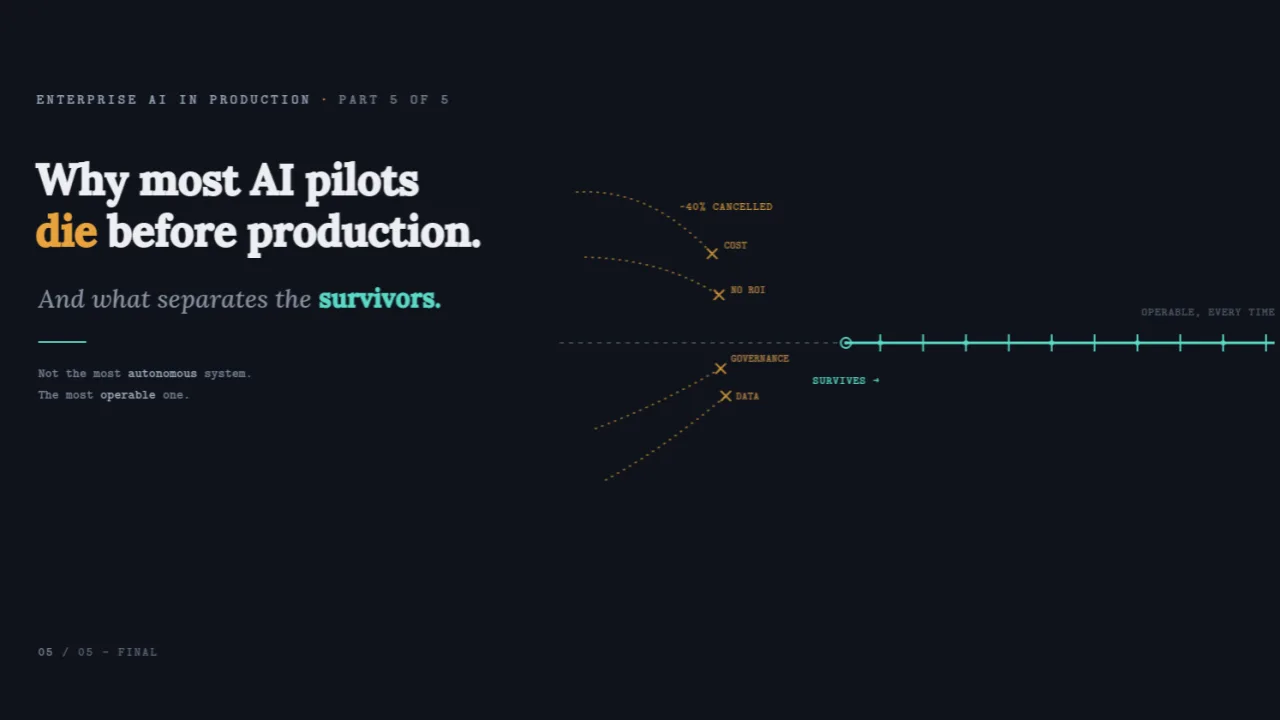
And the projects that start don't all finish. Gartner projects roughly 40% of agentic AI projects will be cancelled by 2027. In survey after survey, only around a third of companies report meaningful returns from generative AI despite serious spend - many investing over a million dollars a year. One striking finding: three-quarters of leaders admit their AI strategy is "more for show" than real operational guidance.
This isn't a story about AI failing. It's a story about AI colliding with production requirements - and most teams not being ready for the collision.
The four ways pilots die
The cancellations cluster into a remarkably consistent set of causes. Every one of them is something this series has been circling.
Runaway cost. Agents reason continuously and bill continuously. When no one can predict what a decision costs, finance doesn't scale the system - they kill it. (Part 2.)
No clear ROI. Individual users get impressive productivity gains, but the enterprise P&L doesn't move. Without per-decision metrics, a pilot is an expensive experiment with no accountability, and experiments get defunded. (Part 2.)
Governance and compliance failures. Autonomous systems misinterpret goals and act confidently outside policy. Roughly a third of adopters have no formal supervision plan for their agents. When trust can't be established, the project stalls at the pilot gate. (Part 3.)
Data and security exposure. Data problems are the single most-cited obstacle, and shadow AI has created real breaches. Uncontrolled agent access across systems turns a productivity tool into a liability. (Part 3.)
Notice what's not usually on this list: "the model wasn't smart enough." Capability is rarely the thing that kills a pilot. The operational envelope around the capability is.
What the survivors do differently
The projects that make it to production tend to share a handful of traits, and none of them are about having a better model.
They go narrow and deep, not broad and autonomous. One painful, high-value workflow, taken end-to-end, with measurable ROI and a real audit trail - instead of a sprawling agent that does a little of everything and can't prove its value anywhere.
They instrument cost and outcomes from day one. They can answer "what does a decision cost and what did it return" before finance ever asks. That single discipline is what turns a pilot into a fundable line item.
They earn autonomy instead of leading with it. They start with tight human oversight and deterministic guardrails, and expand the agent's authority only as trust accumulates. Autonomy is the reward for reliability, not the starting position.
They build the boundary deliberately. They treat "where reasoning happens vs. where execution happens" as an architectural decision they own - the two-engine model from Part 4 - rather than hoping one monolithic agent handles everything gracefully.
They invest in the unglamorous surrounding system. Evaluation, observability, guardrails, audit logging. The stuff that doesn't demo well but is exactly what a regulated buyer needs to say yes.
The takeaway for the whole series
The future of enterprise AI isn't the most autonomous system. It's the most operable one.
The winners won't be the teams with the flashiest agents. They'll be the teams who know when to think, when to execute, and when today's expensive reasoning should become tomorrow's cheap, auditable, deterministic capability.
That's the difference between an impressive demo and a production-grade AI platform. It always was. The market is just now catching up to it - which means there's still a real advantage for the teams who internalize it early.
This concludes the five-part series on enterprise AI in production. If you've been following along - thank you. I'd love to keep the conversation going.
For those of you who've taken agents into production or watched a pilot stall: what actually killed it, or what actually got it over the line? The honest post-mortems are worth more than any vendor deck right now.
About the Author
Praveen R is VP, Software Development at Founding Minds. He leads global software development teams and brings 13+ years of product experience across ERP, CRM and e-commerce. He has built fintech and healthcare products since 2013.