
The Enterprise Agent Control Plane Is Becoming the Real AI Platform
 Praveen R
Nov 2026
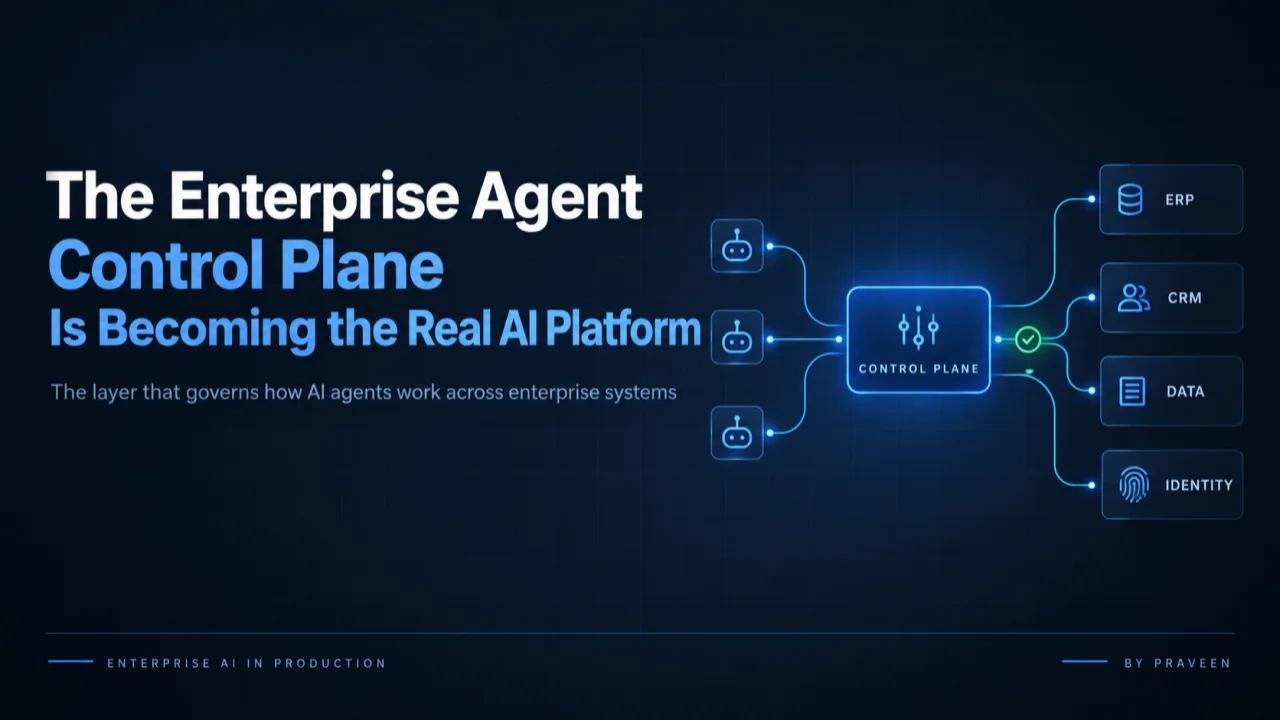
AI agents are moving into business workflows. The challenge now is to govern what they can do across the systems enterprises already use.
Enterprise AI has spent the past few years focused on a familiar question: Which model is best?
That question still matters. But as companies move from chatbots and copilots to agents that can retrieve information, call tools, and take actions, another question is becoming just as important:
How can an organization see and control what its agents are doing across the business?
Recent announcements from HPE and NVIDIA, Microsoft, and Salesforce point to a growing answer: an agent control plane—a layer for managing agent identity, access, activity, and policy. The offerings differ, but they reflect a shared concern. Once agents begin acting across business systems, enterprises need more than a way to build them. They need a way to operate them safely.
Is this a new core layer of enterprise architecture? It could be. But it is not simply a new ERP.
A control plane is not a system of record
An ERP holds authoritative business data and processes transactions across functions such as finance, procurement, inventory, and HR. A customer relationship management system manages customer records and sales workflows. These systems remain the places where business records are stored and updated.
An agent control plane has a different role. It helps manage how agents interact with those systems: which agents exist, what permissions they have, what actions they take, and when a person must review a decision.
Consider an invoice agent. It might read an invoice from a document system, compare it with purchase-order data in the ERP, and prepare a payment in a finance application. The control plane could give the agent its own identity, limit its access to relevant records, require approval above a payment threshold, and record the steps it took.
The ERP still owns the transaction. The control plane governs the agent’s path to it.
If control planes take on more workflow orchestration, approvals, and cross-system execution, they may overlap with some ERP capabilities. But their wider purpose is to coordinate agents across the ERP and the rest of the enterprise toolset.
Why agents change the operating problem
Traditional software usually follows a defined sequence of instructions. An AI agent can interpret a request, choose among tools, and take different steps depending on what it finds.
That flexibility makes agents useful. It also makes them harder to manage with controls designed for conventional applications.
Knowing that an agent exists does not tell IT whether it has more access than it needs. Logging an agent’s actions helps with investigation, but does not necessarily stop an unauthorized action. A written policy may define what should happen, but it does not enforce that policy at the moment the agent calls a tool.
Enterprises need to answer operational questions:
- Which business systems can the agent access?
- Can it read data, change records, or only draft a proposed change?
- Which actions require a person’s approval?
- Can the organization trace a result back to the request, agent, model, and tools involved?
- Can an operator pause the agent or revoke its access?
- Can the same rules apply when agents run on different platforms?
The control-plane idea is an attempt to answer these questions consistently.
How it connects to existing enterprise tools
In most organizations, a control plane would sit across existing systems rather than replace them. It would connect to business applications, identity systems, AI services, data platforms, and monitoring tools.
The connections may use familiar mechanisms: APIs and application connectors, identity and access management, tool gateways or agent runtimes, event streams, audit logs, and existing workflow approval systems.
For example, an agent may use the same ERP API as a human or another application. A control layer can help assign the agent a distinct identity and check whether a particular action is permitted. Activity can then be recorded for security operations and compliance teams, while sensitive decisions can be routed through existing approval workflows.
The quality of the integration matters. A dashboard that lists agents is useful, but it does not guarantee control. If an agent can connect directly to an application and bypass the policy checks, the control plane may have only partial visibility.
The key architectural question is where enforcement happens. Stronger designs check policy in the agent runtime, tool connection, API gateway, or business application before an action changes a record. For important transactions, the business application should continue to enforce its own permissions and validation rules.
The biggest challenge: consistent enforcement
The hardest problem is enforcing consistent controls across a fragmented tool stack.
Enterprises already use many business applications, cloud platforms, identity providers, data stores, and AI services. Agents may be built by different teams, run on different platforms, and connect to systems through different interfaces.
A control plane may work well inside one vendor’s environment while seeing only part of the wider organization. Some integrations may expose detailed activity and allow policy enforcement; others may provide only basic logs. If an action can bypass the control layer, the organization cannot assume that its central policies are being applied everywhere.
This challenge is organizational as well as technical. AI teams may build agents, IT may own identity and infrastructure, security may define access rules, and business teams may own the workflows. Those groups need to agree on which actions are allowed, who approves exceptions, who responds to incidents, and who is accountable for outcomes.
The control plane can provide shared mechanisms, but the organization still has to define the rules and make sure they reach the systems where agents act.
What a production-ready control plane needs
A useful control plane should do more than display a list of agents. It needs to connect an agent’s authority to its actual behavior.
Inventory and ownership: Teams should be able to find agents, identify the people responsible for them, and understand their purpose and dependencies.
Agent identity and permissions: Each agent should have an identifiable account with access limited to the task it performs. Broad shared credentials make it difficult to determine which agent took an action or to limit its access.
Action-level policies: Reading a record, drafting a message, sending it, and changing a financial record carry different levels of risk. Policies should reflect those differences.
Human review: Sensitive actions may require approval or confirmation. The review thresholds should match the business risk without routing every routine task through a person.
Observability and investigation: Operators need enough context to trace a task from the request through the agent’s decisions and tool calls to the final outcome.
Incident controls: Teams should be able to stop an agent, revoke its access, and investigate what happened. Where possible, they should also be able to reverse or contain its effects.
Cost and outcome measurement: Tracking usage is useful, but token counts alone do not show whether an agent is worthwhile. Teams need to compare the cost of a workflow with the work it completes and the value it delivers.
These capabilities are related. A record of an agent’s activity is more useful when it includes the identity and permissions under which the action occurred. A policy is more useful when it is checked before the action takes place. And an approval process is more effective when it is reserved for decisions that carry meaningful risk.
Central standards, local workflows
A control plane also has to balance enterprise-wide standards with the needs of individual teams.
A central security or platform team can set baseline rules for identity, access, audit trails, and incident response. Business and application teams still need to decide which actions are appropriate in their workflows and where human judgment is required.
If each change requires a manual ticket and review, teams may find ways around the process. If local teams can configure agents without common guardrails, access and accountability may become inconsistent. A workable approach gives teams room to build and improve workflows within controls that are centrally defined and technically enforced.
Questions to ask before adopting one
A product demo can show agent inventories and dashboards. A real evaluation should test how the platform behaves in the systems where work happens.
- Can it discover agents running outside its own platform?
- Can every agent have its own identity and limited permissions?
- Can the control plane block a specific action before it changes a business record?
- Can it require approval for a defined class of actions?
- Can operators trace a task from the original request through to the outcome?
- Can they pause an agent and revoke its access quickly?
- Do policies apply across different models and deployment environments?
- Can the organization connect cost to completed business work?
One practical test is to configure an agent that can read a customer or invoice record but cannot change it without approval. Then verify that the change is blocked, the approval is routed correctly, and both the allowed and blocked actions appear in an audit trail. That reveals more than a product overview can.
The layer between agents and enterprise systems
The agent control plane is becoming a serious architectural conversation because agents introduce a new operational unit: software that can interpret goals and act across business systems.
It is not the new ERP. It is a potential layer between agents and the tools where business data and transactions live one that can make agent access more visible, consistent, and governable.
Whether it becomes a core part of enterprise architecture depends on execution. The control plane must work across vendors and environments, enforce rules where actions happen, and fit into existing identity, security, and approval processes. Without that, it risks becoming another dashboard that reports on activity without controlling it.
The most important test is simple:
Can the enterprise understand and control an agent’s next action before it changes something that matters?
That is where production readiness begins.
About the Author
Praveen R is VP, Software Development at Founding Minds. He leads global software development teams and brings 13+ years of product experience across ERP, CRM and e-commerce. He has built fintech and healthcare products since 2013.