
Reasoning is expensive. Execution should be cheap.
 Praveen R
Jun 2026
Enterprise AI in Production - Part 2 of 5
In Part 1, I argued that production doesn't want more AI - it wants predictability. The first place that abstract idea becomes concrete and painful is the invoice.
The bill nobody modeled
Agents don't stop. That's the point of them - and also the problem.
A traditional service does work when a request comes in and then goes quiet. An autonomous agent reasons continuously: it plans, re-plans, calls tools, reflects on the result, calls more tools. Every one of those steps is tokens, and tokens are money. Run that pattern 24/7 across a fleet of agents and you've built a system whose cost scales with how much it thinks, not with how much value it delivers.
This isn't a fringe concern anymore. Runaway cost is now one of the most-cited reasons enterprise agent projects get canceled, and "FinOps for agentic AI" has become a named discipline for a reason - Gartner projects roughly 40% of agentic AI projects will be canceled by 2027, and cost with no clear ROI sits near the top of the kill list. When finance can't predict what a decision costs, they don't scale the system. They shut it down.
Why per-decision cost is the metric that matters
Here's the question that separates a demo from a platform:
What does one decision cost - and is that cost bounded?
In a deterministic system, the answer is trivial and stable. A rule evaluates. The cost is a rounding error, and it's the same today as it will be next quarter.
In a fully agentic system, the answer is "it depends" - on the prompt, the number of reasoning loops, the tools invoked, the model version, and how ambiguous the input happened to be that day. You can't put "it depends" in a pricing model. You can't put it in a capacity plan. And you certainly can't defend it to a CFO who just watched individual employees get a 5x productivity boost while the company-wide P&L didn't move - the productivity-to-ROI disconnect that's frustrating leadership across the board.
The trap of paying to re-derive what you already know
The subtle waste isn't the hard problems. It's the easy ones.
Most enterprise work is repetitive. The same categories of request, the same handful of resolutions, over and over. If your agent reasons its way from scratch through a problem it has already solved a thousand times, you are paying premium token prices to re-derive a conclusion you could have cached as a rule.
That's the core inefficiency: using your most expensive, least predictable component for your most routine, most predictable work.
The move: let reasoning earn its retirement
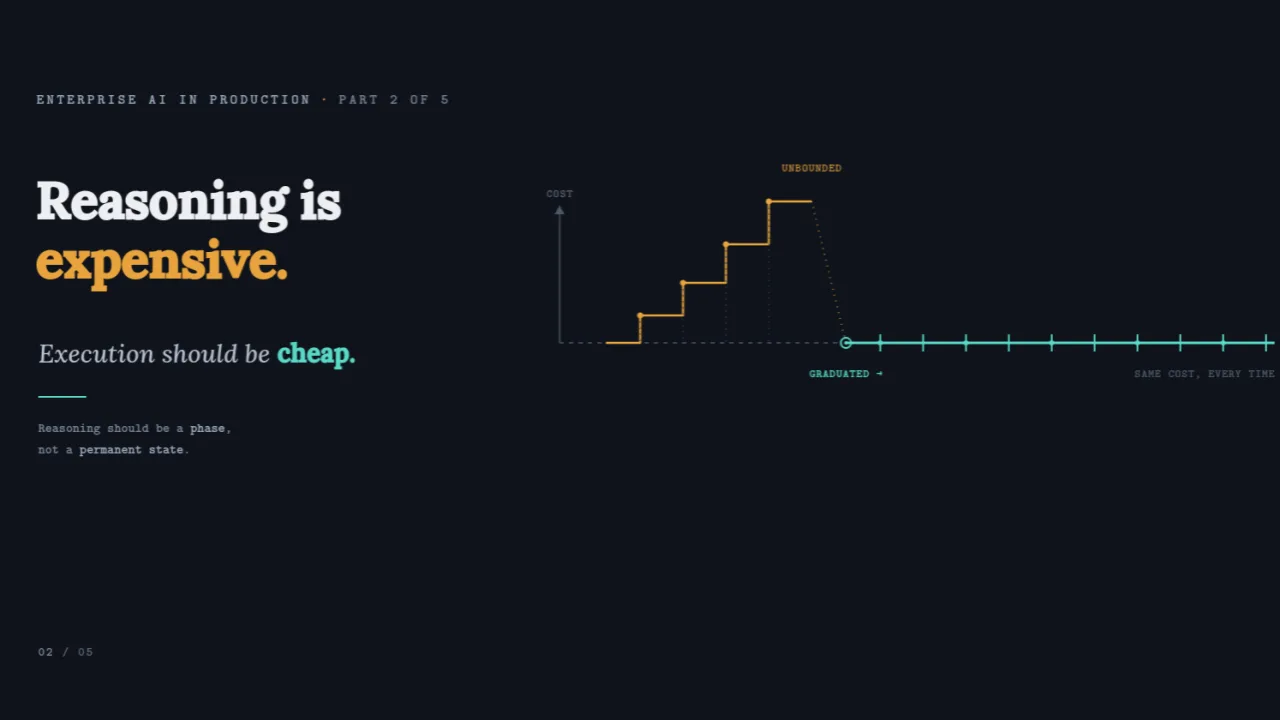
The discipline I keep coming back to is this - reasoning should be a phase, not a permanent state.
Use AI reasoning where the problem is genuinely novel or ambiguous. But the moment the system solves a class of problems reliably and repeatedly, harvest that. Turn the discovered behavior into a deterministic path: a rule, a workflow, a cached decision, a small piece of ordinary code. From then on, that work runs cheap, fast, and identically every time.
You don't lose the intelligence. You bank it. The agent moves on to the next frontier of ambiguity, and the solved work stops costing you tokens forever.
Reasoning is how you discover the answer. It shouldn't be how you deliver the answer for the ten-thousandth time.
What this changes in practice
Once you accept this, a few things fall out naturally.
You start instrumenting cost per decision as a first-class metric, not an afterthought. You start looking for "graduation candidates" - behaviors stable enough to convert from reasoning to execution. And you start treating token spend the way you'd treat any other unbounded resource in production: with budgets, alerts, and a bias toward moving load off the expensive path.
The goal isn't to minimize AI. It's to make sure you're only paying for reasoning where reasoning is actually creating new value.
This is Part 2 of a five-part series. Next: audit, compliance, and trust - why enterprises are buying confidence, not capability.
How are you tracking the cost of an agentic decision today - and have you started converting your stable, high-volume workflows off the reasoning path? I'd genuinely like to compare notes.
About the Author
Praveen R is VP, Software Development at Founding Minds. He leads global software development teams and brings 13+ years of product experience across ERP, CRM and e-commerce. He has built fintech and healthcare products since 2013.