
Production doesn't want more AI. It wants predictability.
 Praveen R
May 2026
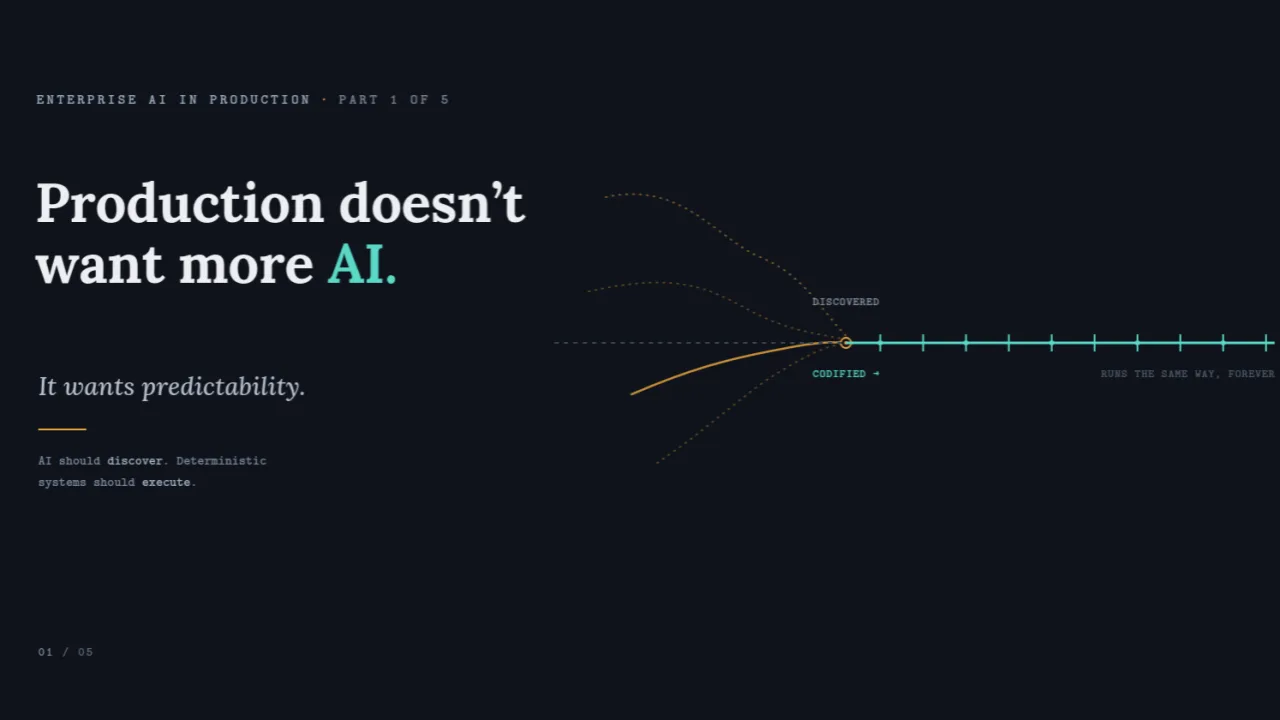
Enterprise AI in Production - Part 1 of 5
Last year, many of us built impressive agentic AI demos.
This year, we're trying to put those same systems into production.
That's where the real lessons begin.
The demo and the deployment are two different worlds
In a demo, the AI decides everything. Agents plan dynamically. Autonomous execution looks magical. Every problem feels solvable through reasoning.
In production, the questions change completely:
Can we audit this? Why did the AI make this decision? Can we reproduce the same result tomorrow? What happens when the model changes underneath us? Can a regulator inspect the decision path? Can we guarantee an SLA? And how much does every single decision cost?
None of these are AI questions.
They're enterprise software questions - the same ones we've been answering for distributed systems for twenty years. Agentic AI doesn't get to skip them just because there's a language model in the loop.
The tension inside every company right now
There's a conversation happening on nearly every AI roadmap.
Executive teams say: "Let's build fully autonomous agents."
Engineering teams say: "We need deterministic systems."
Neither side is wrong. They're optimizing for different things. Executives optimize for innovation and differentiation. Engineers optimize for reliability, cost, and the pager not going off at 2 a.m.
The mistake is treating this as a debate to be won. It isn't. It's a boundary to be drawn.
The architecture most teams reach for first
Request → Autonomous Agent → Everything.
It works beautifully in the demo. It keeps working through the first few dozen happy-path cases.
Then you add thousands of customers, auditors, a compliance review, a model upgrade, and your first real production incident - and the same architecture that felt magical becomes the thing you can't reason about, can't bound, and can't defend.
A better question
Instead of asking "Should AI replace deterministic systems?", ask:
"Where should reasoning actually happen?"
Reasoning and execution are different problems, and we keep conflating them.
AI is genuinely excellent at understanding ambiguity, planning, discovering new patterns, handling exceptions, and interpreting unstructured information.
Deterministic systems are genuinely excellent at repeatability, auditability, compliance, cost control, predictable execution, and SLA guarantees.
You don't want a language model deciding, on every invocation, how to format an invoice it has already formatted correctly ten thousand times. You want it to have discovered the rule once - and then you want that rule to run for a fraction of a cent, the same way, forever.
The pattern I'm starting to believe in
AI should discover. Deterministic systems should execute.
Every time AI reliably solves a new class of problems, you convert that learning into a deterministic workflow. You stop paying tokens forever for something the system already understands.
Reasoning is expensive. Execution should become cheap.
That single sentence reorganizes how you think about the whole platform - and it's the thread I'm going to pull on across the rest of this series.
My biggest takeaway
The future of enterprise AI isn't about replacing deterministic software.
It's about knowing when to think, when to execute, and when today's AI reasoning should become tomorrow's deterministic capability.
That may turn out to be the real difference between an impressive demo and a production-grade AI platform.
This is Part 1 of a five-part series on what actually happens when agentic AI meets production. Next: the cost argument - why reasoning is expensive and execution should be cheap.
I'm curious whether others are seeing the same shift. Are your teams pushing toward fully autonomous agents - or are your production systems quietly settling into a hybrid architecture? I'd like to hear where you've drawn the line.
About the Author
Praveen R is VP, Software Development at Founding Minds. He leads global software development teams and brings 13+ years of product experience across ERP, CRM and e-commerce. He has built fintech and healthcare products since 2013.