
Architecting Agentic AI: The Engineering Logic Behind Autonomous Agents
 Praveen R
Apr 2026
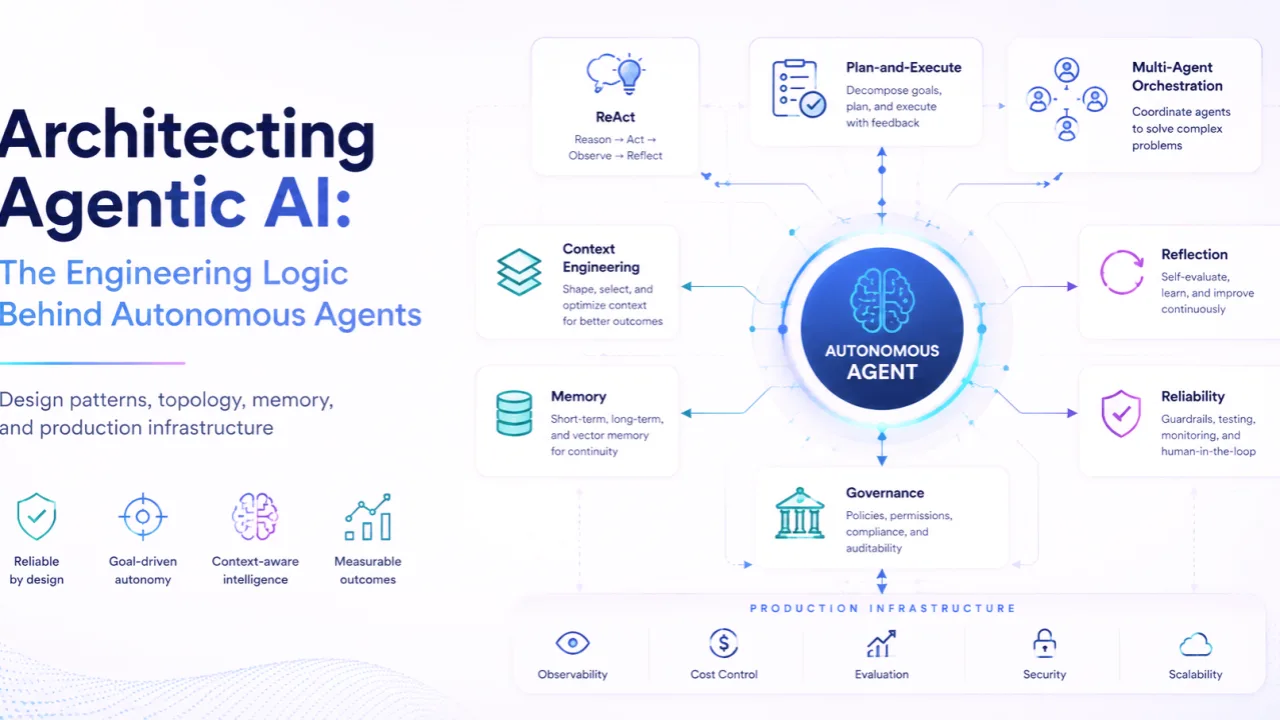
Autonomous AI agents are quickly moving beyond simple chat interfaces and experimental demos.
We are now seeing agents that can reason through tasks, use tools, plan multi-step actions, coordinate with other agents, reflect on their own outputs, and interact with external systems. But as these systems become more capable, the engineering challenge becomes more serious.
The question is no longer only:
Can an LLM call a tool?
The better question is:
How do we design agentic systems that are reliable, predictable, cost-aware, observable, and safe enough for real-world use?
Why agent architecture needs better vocabulary
A lot of AI agent discussions focus on structural patterns: one agent, multiple agents, tool calling, workflows, loops, memory, and orchestration.
That is useful, but it is not enough.
Two systems can have similar data flow but behave very differently depending on what the agent is expected to do. One agent may simply decide which tool to call next. Another may create a plan, revise it, delegate tasks, inspect intermediate results, and coordinate multiple steps toward a goal.
At a high level, we need to understand agents through two dimensions.
The first dimension is cognitive function. What kind of thinking is the agent doing? Is it reasoning, planning, deciding, reflecting, coordinating, or executing?
The second dimension is execution topology. How is the system structured? Is it a loop, a planner-executor pattern, a workflow, or a multi-agent orchestration model?
This combination gives us a clearer way to classify agentic systems.
ReAct: reasoning and acting in a loop
One of the foundational patterns in agentic AI is ReAct, which combines reasoning and action.
In a ReAct-style system, the agent observes the current state, reasons about what to do next, chooses an action, calls a tool, receives the result, and continues the loop.
This is powerful because it allows the agent to adapt step by step. It does not need to know the full path in advance. It can inspect results and decide what to do next.
But this flexibility also creates risks.
The agent may loop too long. It may call unnecessary tools. It may make inconsistent decisions across steps. It may lose context or become expensive if not carefully controlled.
So ReAct is useful, but it needs guardrails: step limits, tool boundaries, logging, fallback paths, and clear stopping conditions.
Plan-and-Execute: separating strategy from execution
Another important pattern is Plan-and-Execute.
Here, the agent first creates a plan. Then the system executes the plan step by step, sometimes using the same model, sometimes using smaller models or deterministic application logic.
This pattern is useful when the task has multiple stages and benefits from upfront structure.
For example, instead of asking an agent to “complete this complex task” in one continuous loop, we can ask it to break the task into smaller actions first. Then each action can be executed, validated, and monitored separately.
This improves control and observability.
But planning also introduces another problem: plans can be wrong. A plan may look logical at the beginning but fail when real data, tools, constraints, or user inputs are involved.
That means production systems need plan validation, replanning, error handling, and sometimes human review.
Multi-agent orchestration: coordination is the hard part
Multi-agent systems are often presented as a natural next step: one agent for research, one for planning, one for coding, one for review, and so on.
This can work well when roles are clearly separated.
But multi-agent systems also add complexity. Communication between agents can become noisy. Responsibility can become unclear. Errors can spread from one agent to another. Costs can increase quickly. Debugging becomes harder.
The key question is not simply whether we can use multiple agents.
The better question is whether multiple agents reduce complexity or increase it.
A multi-agent architecture is useful only when separation of responsibility improves the system. Otherwise, a simpler workflow or planner-executor design may be easier to govern and scale.
Production concerns matter as much as patterns
The real test of agentic AI is not whether a demo works once.
The real test is whether the system works repeatedly, under changing inputs, with clear limits, measurable behavior, and acceptable cost.
That brings several engineering concerns into focus.
Context engineering becomes critical because the agent’s behavior depends heavily on what information it sees and when it sees it.
Memory needs careful design because not every past interaction should be remembered, and not every memory should influence future decisions.
Reflection can improve quality, but it can also add latency and cost if used everywhere.
Reliability requires retries, fallbacks, validation, and deterministic checks around the LLM.
Cost control requires model selection, token budgeting, caching, and monitoring.
Governance requires audit logs, human oversight, permission boundaries, and clear accountability.
These are not optional details. They are part of the architecture.
From prototypes to production systems
Many agent prototypes feel impressive because they show autonomy. But production systems need more than autonomy.
They need control.
A useful agentic system should know what it is allowed to do, when to stop, when to ask for help, when to use tools, when to trust memory, and when to escalate to a human.
That is why agentic AI architecture is not just about prompts or model capability. It is about designing the surrounding system.
The future of AI agents will not be decided only by more powerful models. It will also depend on better engineering patterns, clearer abstractions, stronger observability, and responsible governance.
About the Author
Praveen R is VP, Software Development at Founding Minds. He leads global software development teams and brings 13+ years of product experience across ERP, CRM and e-commerce. He has built fintech and healthcare products since 2013.