
Teaching software to understand what it sees.
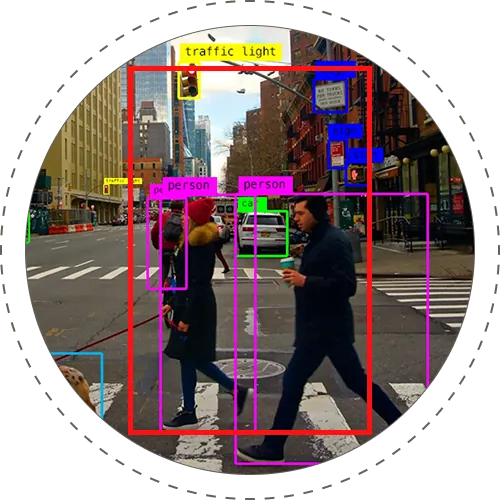
Images and video hold more than objects to recognize. We build computer vision systems that detect events, track movement, interpret visual conditions, and turn what a camera sees into information applications can use. The engineering has to account for the environment, the cameras, the computing available, and what happens when the model gets something wrong.
Four groups of vision engineering.
A camera is a cheap, flexible sensor. Computer vision turns what it records into events, positions and measurements that software can act on.
Seeing
Detecting and recognizing objects, and recognizing activities and events as they happen.
Following
Tracking objects and movement across frames, and working out where things are in space.
Measuring
Pulling measurements and structured data out of visual input: positions, trajectories, timings.
Delivering
Running on live video within latency, bandwidth and compute limits, handling confidence and human review, and feeding results into the application around them.
Not every technique appears in every project. The examples show where each one has been used.
Three different problems, one discipline.
Turnaround events used to be logged by hand on handheld devices, while the crew was doing the work. AutoATOps reads the airport’s existing camera feeds, recognizes events such as aerobridge connection, cargo door operation, and cargo and catering loading, and timestamps each one. It observes and records. Operational decisions stay with the ground crew.
A pitch is over in a fraction of a second. BullpenAI pairs high-speed cameras with computer vision, and a radar gun for velocity, to measure trajectory and location, call each pitch a strike or a ball, and place it in one of nine zones. Biomechanical analysis follows the pitcher’s body movement. Every pitch is stored, so coaches and players can replay it and compare sessions.
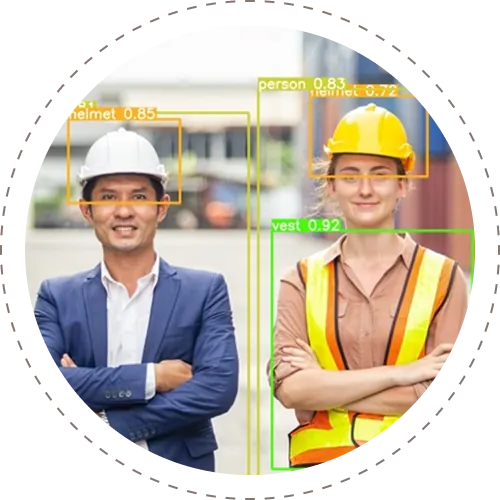
Proktor runs detection on the worker’s own machine and looks for defined security events: a phone in view, an additional person, a sensitive document visible in the workspace. Image anonymization reduces how much identifiable imagery is exposed, and detections go to authorized teams. Proktor is a JIFFY.ai product that Founding Minds engineered.
In a dental care platform, photos uploaded by patients feed an online assessment and treatment planning. They come from phone cameras in ordinary lighting at whatever angle the patient chose, and the output is there to support a clinician’s assessment, not to replace it.
Detection is the starting point
A detection is only useful once the application around it does something with it.
Research behind the vision work.
The patents concern tracking moving objects in games. The papers cover medical imaging and image restoration.
Patents
Two further US applications are published.
Peer-reviewed papers
Real environments are hard on vision systems.
No vision system detects everything or works everywhere. These are the conditions that cause trouble, and what we do about them.
Many vision models provide confidence scores alongside their detections. Deciding when to accept a result, flag it for review, or disregard it is part of designing the application around the model.
Where vision work runs, and where it fits.
Many vision systems have to process video close to the camera, for reasons of privacy, latency or connectivity. That is covered on the Edge & On-Premises AI page.
Edge & On-Premises AI →Application Modernization
Add vision-based observation, event detection or visual data interpretation to established applications and operations.
Application Modernization →MVP in a Box
Build new products that use visual information as an important part of the experience.
MVP in a Box →Have an AI engineering challenge?
Whether you’re modernizing an existing application or engineering a new AI-native product, we can help determine the right approach.